Showing posts with label Cathedral of Saint Matthew the Apostle. Show all posts

Friday, October 7, 2011

Prepare to Share the New Evangelization


"New Evangelization can succeed when it comes from a humble place." stated C. Colt Anderson while speaking at the Cathedral of Saint Matthew the Apostle as part of the Fall Lecture Series on Thursday, October 6. His lecture titled What Is The New Evangelization? was presented on Thursday, October 6. This lecture was conversational in tone, integrated questions from the audience, and included a digital slide presentation.

Many Catholics do not like the word evangelical because some Protestant denominations have taken the word and applied it to their ministries which often are biased against Catholicism.

What is the New Evangelization
C. Colt Anderson speaks at the Cathedral of Saint Matthew the Apostle.


"To be Catholic means you have to be evangelical," stated C. Colt Anderson. "All we have to do is repent and call people to convert. The Council of Trent encourages us to keep trying, encourages us to remain in some mode of conversion."

Evangelization can help remind people about the deeper meanings of their faith. Evangelization can reinforce the necessity of penance, the necessity to repent, the necessity of prayer, the necessity of doing works of charity. There is also the message that we are all going to be judged by God for all of our actions some day. We are all going to be held accountable for our actions, for our ability to love, for our ability to forgive.

"The Church has lost the sense of urgency. The urgency that we're talking about is forgiveness and how important that is." said Mr. Anderson. "God is willing to forgive us."

Many people have drifted away from thinking about God's justice. There appears to be a belief that by attending Mass each Sunday, doing works of charity insures entrance into the Kingdom of heaven. Those activities help but they do not guarantee it. Many people today do not have a sense of being judged or a sense of accountability for their sins and wrongdoing.

Catholics believe in redemption. Catholics believe in salvation. The sacrifice of Jesus Christ allows us to be redeemed, to be saved. The sacrifice of Jesus Christ presents each Christian with an opportunity for salvation.

What is the New Evangelization
C. Colt Anderson listens to questions about New Evangelization.


Mr. Anderson said, "God brings good out of the evil we do and the evil we suffer. God brings some meaning into the narrative of our lives."

There was a brief discussion of rhetoric. An overview of apologetics, polemics, catechesis was presented. Effective evangelization begins with knowing, understanding, and respecting your audience explained Mr. Anderson. "Be plausible, be brief, be clear." 

The main goal of New Evangelization is to get lapsed Catholics to reconnect with the Church. "Lay people are asked to share their faith. Lay people are asked to teach about their personal experience as a Catholic. Lay people are asked to share their delight in their faith. Lay people are asked to  persuade people to return to the Church."

The call to conversion remains the responsibility of all Christians. "We have to witness for our faith." stated Mr. Anderson. "Being Catholic is the best and safest way to salvation."


The Making of an Evangelist

Fall Lecture 5
Msgr. Peter J. Vaghi speaks at the Cathedral of Saint Matthew the Apostle.

Monsingnor Peter J. Vaghi, pastor at Church of the Little Flower in Bethesda MD, presented a theological reflection titled Encountering Jesus in His Word: The Making of an Evangelist  on Thursday, October 6  at the Cathedral of Saint Matthew the Apostle.

This was the first of eight monthly reflections which are scheduled to occur on the First Thursday at the Cathedral immediately following the 5:30 P.M. Mass.

"Christian life is essentially marked by an encounter with God asking us to follow him."  explained Monsingnor Vaghi.

There is, within each encounter with God, a challenge for each Christian to be more faithful in his life, to make changes to be more obedient to God.

"Peter is a model for us to follow as we evangelize." stated Monsingnor Vaghi. "Peter is a model for what it means to be an evangelist."

Holy Scripture passage Luke 5:1-11 was read by Monsignor Vaghi.

"Listening to his word, the people encountered Jesus."  said Monsignor Vaghi as he briefly described the day to day ministry of Jesus and the crowds of people who were following him. There is a significance that Jesus chose Peter's boat to get into and to continue teaching the people. There were other boats which he could have used. But Jesus chose to be close to Peter.

Fall Lecture 1
Msgr. Peter J. Vaghi listens to a question about evangelization.

 After he had finished talking to the crowd Jesus asked Peter to take his boat out to deep water and lower his nets. Peter said "Master we have worked hard all night and have caught nothing but at your command I will lower the nets."  Peter's response could be interpreted as apostolic toil, working hard as an apostle. Within Peter's response exists a sense of weariness, lack of confidence, sense of defeatism.

"Peter could have rejected the request of Jesus. Peter decided to obey the word of Jesus, the word of God." explained Monsignor Vaghi. "He obeyed the Word of God. He trusted the word of Jesus. He  allowed the movement of the spirit in his life. In the process he became a changed man."

Jesus provided a simple lesson for Peter on being obedient to God. Jesus showed Peter that obeying the word of God could lead to great success.

"We must take risks for Jesus. We are asked to challenge our friends, to challenge our family members to return to Church. We are to challenge their beliefs, to persuade them to believe that to live in such a way that one's life without God does not make sense."

On that fishing boat Peter came to terms with his weakness, with his unworthiness to be an evangelist. He was overwhelmed by his personal sinfulness.

Fall Lecture 4
Msgr. Peter J. Vaghi responds to a question about encountering Christ.

"We must pray to come to terms with our own sinfulness to be effective evangelists." said Monsignor Vaghi.

Thursday, October 6, 2011

All Catholics Asked to Evangelize


C. Colt Anderson spoke at the Cathedral of Saint Matthew the Apostle after the Wednesday 12:10 Mass as part of the parish Fall Lecture Series. Mr. Anderson's topic was "What is the New Evangelization?" The lecture was arranged by the Faith Formation Committee. 

The lecture was part history of the New Evangelization movement and part application techniques. The aim of this lecture was to motivate people to evangelize, to share the stories of their conversion and belief in God, and to encourage others to share their stories.


C. Colt Anderson speaks about New Evangelization.


"The aim of New Evangelization is directed toward lapsed Catholics, Catholics who have fallen away from their faith," explained Mr. Anderson. "New Evangelization is really re-evangelization."

New Evangelization comes out of an European and secularization context with different levels of government involvement, explained Mr. Anderson. “Now New Evangelization needs to be translated in an American context.”

Mr. Anderson explained that evangelical is the Greek word for gospel. Gospel means the Good News. "Being evangelical means being in agreement with the Gospel, at least in theory. We can at least say we agree with the Gospel." 

Mr. Anderson acknowledged that most American Catholics are uncomfortable with using the term because the word evangelical is often associated with fundamentalist Christian groups.

Evangelization is the work that is assigned to the laity, that is best done by the laity.

We find faith by hearing it spoken, by hearing it proclaimed. New Evangelization is a request for faithful believers to share their stories, to share their faith. "We have to proclaim the full significance of Christ."

Baptism admitted each Catholic to a holy priesthood. We are asked to give an account, to spread, and to defend the faith by word and deeds.

"The agent of the New Evangelization has to be a lay person. We all have had problems with the Church." stated Mr. Anderson. "We live in the world. It is easy to dismiss a priest. Lay people have to take up half of the task of evangelization."

Mr. Anderson provided simple instructions on how to prepare to be an evangelist. The most important items are know your audience and ask and then listen to their response to why they think how they do.

"People really are different. Some are motivated by love., some are motivated by fear. Different people are motivated by different things. People have different strengths, weaknesses, vices." declared Mr. Andesrson "Each person's spirituality is also different. Never presume that others have to follow your path."

C. Colt Anderson speaks at the Cathedral of Saint Matthew the Apostle.


A brief lesson on rhetoric was presented. The aim of New Evangelization is to persuade the lapsed Catholics to return to the church community. Anderson stated that many of the Catholics who have left the faith will be hostile.

Mr. Anderson briefly described apologetics, catechesis, polemics and explained how and why they can be useful when discussing your faith with someone. He provided good advice about being polite, being attentive what the person is saying. Being honest is important when discussing the Church. Mr. Anderson stated that it is better to state the problems with the Church instead of whitewashing them. “Evangelization requires truth.”

"The aim is to win them over, not to beat them up." declared Mr. Anderson. "Christ was humble, shouldn't his disciples be humble too? Humility is attractive."

Wednesday, October 5, 2011

My Afternoon

This afternoon I attended a lecture called “What is New Evangelization?” The lecture was held at the Cathedral of Saint Matthew the Apostle. C. Colt Anderson Vice-President for Academic Affairs & Academic Dean, Washington Theological Union presented the lecture which lasted for approximately one hour.

Mr. Anderson stated that many American Catholics are uncomfortable with the word evangelical because of its association with some fundamentalist Christian groups.

“The aim of New Evangelization is toward lapsed Catholics, Catholics who have fallen away from their faith,” declared Mr. Anderson. “New Evangelization comes out of an European and a secularization context. Now it needs to be translated into an American context.”

Evangelical is a Greek word which means gospel.


Thursday, September 22, 2011

The Cathedral of Saint Matthew the Apostle celebrated the Feast of Saint Matthew on Wednesday, September 21 at all the Masses.

The First Reading was from Ephesians.

The Gospel Reading was from Matthew.

Thursday, September 8, 2011

Thoughts for a Rainy Week

This city is often filled with tourists behaving like tourists with cameras and maps and questions for hurried, harried residents slightly amused, slightly frightened by these strangers with accents. The summer is filled with all colors and fabrics and voices talking, laughing, asking for directions to the Zoo, to MacDonalds, to the Cathedral.


July contains an emotional shift of opportunity, playfulness as weekend trips away dominate many conversations. There are always sights, sounds, sales. Pedestrians often have pouting defiant lips. Everyone wears flip-flops. Everyone has bare ankles. Everyone yells into their cell phone from time to time. There is a subtle anxiousness, a nervous stammer. For everyone looks at the faux leather skirts, faux leather purses, everyone notices something which will not be mentioned now but will be shared with friends during dinner and happy hour. There are thigh high black leather go-go boots. There are kittens in well ventilated black mesh bags. There are people pointing, people waiting to cross the street.


I walk to the Cathedral of Saint Matthew the Apostle each day aware of the waves of hope, waves of hopelessness. There is anxiety. There are questions about the tidal basin. There is motion, lots of movement. There are faces, there are helmets. Moving through the city is a highwire act requiring balance, confidence, looking forward, looking upward. There is noise, groans, grunts, gasps, laughter, accents. There is motion. At times I feel as if I am on a bridge not walking by a crowded coffee shop.


And I walk to the Cathedral of Saint Matthew the Apostle, hearing conversations in Spanish, Japanese, Greek, Russian; seeing people smile, laugh, pout, gesture. Sometimes I forget the city streets. Sometimes I imagine the outdoors, trees, the countryside. How great solitude and silence looks from the distance! How grand it would be to rest in the shade of a tree or wander around a pasture. 


Living in this city creates many bucolic diversions while trying to decide whether to have broccoli and goat cheese added to my salad. Living in this city presents many opportunities for goodness, kindness, holiness. Living in this city presents many opportunities for prayer.


There are trees and parks. There is despair. There is silence, hidden suffering. Prayer for everything is needed. 


And I walk to the Cathedral of Saint Matthew hundreds of tourists with cameras and cell phones and plastic bottles and cardboard cups pass by me. There is anticipation, anxiety. The faces are enjoying this moment. Enjoying the humidity. Enjoying the restlessness. Speed is important. Pedestrians race and dodge around each other. Some people bump and nudge on their separate journeys. But, it is important to remember that all those who believe in Christ are never alone, God is always with us.


There is much to see in the city. Each day there are lessons in goodness, lessons in kindness. The city is filled with all types of signs. Summer presents temptations and diversions. Summer reminds us to take time to be pray, to take time to praise and give thanks to God. There are so many signs in the city. Which do we read, which do we obey, which do we remember?


There are so many signposts directing us to God. Which do we read? Which do we obey? Which do we remember?


The Cathedral of Saint Matthew the Apostle is often filled with tourists behaving like tourists with cameras and maps and questions and pointing fingers and waving hands and posing bodies. The Cathedral welcomes all, encourages all to enjoy the silence, to take a moment to offer thanks and praise to God. Here is a place to pray.


Monday, August 22, 2011

A Weekend of Sacraments

On Saturday there were two baptisms, one wedding at the Cathedral. On Sunday there was one confirmation and one baptism in addition to the usual scheduled Masses. Each one of these events reminds all those in attendance of God’s grace and love and provides time for reflection and prayer.

Weddings and baptisms are linked in my mind. They both usually involve white garments. There is participation by the parents in each ceremony. There are questions asked by the priest and answered by the bride and groom.

I had numerous instances to review my view of my life as a Christian this weekend as I went about my daily activities at the Cathedral of Saint Matthew the Apostle.

There was a revelation that there is more work that needs to be done, volunteering more at the Church, praying more. Finding a way to use my life for goodness, holiness, kindness is becoming more important.

Raising a child, having a loving marriage require a lifetime of prayer, support, hope, and love. Fidelity to God, fidelity between husband and wife, fidelity between parent and child are necessary. Friends and family need to practice fairness and compassion always in their thoughts, words, and actions. Remember the local parish community and the universal parish community. Gain strength from them.

It is very important to remember Christ’s love, to remember that we are all adopted children of God, to remember we are all part of a loving prayerful community. We are never alone. There are always fresh footsteps on the ground in front of us. As a community we hopefully remember to pray for all the newly baptized children, newly married couples, newly confirmed individuals.

Christian life begins and ends with prayer. Weddings and baptisms provide a great opportunity for prayer, for the community to come together and welcome the new couple, the new Catholic into the community. Baptisms and weddings provide a moment to look back at the history of the Church, back at the history of our behavior as Christians. We can see our strengths, our weaknesses. We can renew our commitment to God, pray for the strength to change, the strength to become a better Christian.

Everything begins with prayer, everything needs prayer.

Wednesday, August 10, 2011

Prepare before Mass


To proclaim the Good News involves both reading and understanding what you are listening. Holy Scripture is more than a narrative. The words are  beautiful yet immensely public, inspiring sentences and speeches to be shared with others.

Thursday, April 7, 2011

Rosary or Umbrella

Saturday began quietly. There was slight hesitation about whether to go to early Mass or not. The weather forecast was a confusing mixture of clouds and sunshine. A slight debate over which camera, which lenses, which camera bag began. There were more reasons to remain indoors than to leave, there were more reasons to do something else, anything else than to leave and be productive.


Outside there was sunlight caressing one side of the still silent, somehow wonderfully traffic free avenue. There was something gently beautiful about this view, something which provided hope. There was a brief debate over taking photograph or not.

The walk to the Cathedral of Saint Matthew the Apostle continued. There were few pedestrians moving about that Saturday morning. There were joggers and cyclists and dogs on leashes. The air was cool, the sky was blank. People looked liked statues or other inanimate objects.


There were trees without leaves, buses without riders, taxicabs without passengers. There were many things to think about, many things to remember. This was a time for silent prayer, silent reflection. This was a time to remember some of the people that I had promised to pray for. This was a time to remember my own search for my personal sense of humanity. This was a time to remember to pray for strangers. Mass had been missed, the second destination was plotted.

Walking on the sidewalks, jaywalking at some intersections provided a crazy sense of anonymity and anxiety. There was a second or two of calm carelessness as I looked at this glass and steel building. There was a second or two of casual thoughtlessness as I darted into traffic.

Walking south there was a moment when I wondered if I had the wrong date, if this event was going to occur on another future time.

Then, I saw them. It was about twenty people of all ages, standing there holding their rosaries. Some were holding sheets of paper.

Their voices were gentle, merciful, loving. Their manner was civil, polite. They were publicly praying in front of the local abortion clinic. There was one police vehicle on the street.


A priest with a microphone was leading those saying the Rosary. This was a moment of reverence. This was a moment of hope. This was a moment of charity. The voices gently said the Rosary, each mystery was clearly announced. Standing on the edge of a sidewalk near the entrance to the abortion clinic, these Christians peacefully, calmly prayed for life, prayed for those thinking about having an abortion, prayed for those who have had an abortion, prayed for those innocent children who were killed by abortion.

The Rosary is powerful. As Catholics we are taught to respect life, to love our neighbors as we love ourselves. A sign of that love is supporting life, supporting hope. We must remember God, remember goodness, holiness, and kindness.

We must encourage our friends to help with this fight. All human life is important. All human life contains the potential for beauty, for hope, for love.


All human life deserves a chance.


Monday, March 28, 2011

How to Explain

When I originally conceived this essay, I wanted to explain how I spent my Sunday. What I thought about, what I prayed about, what I thought about praying about, where I went. It was arranged in a completely accessible linear fashion. But, how would my story translate to non Catholics, to non Christians. Is there something universal in my activities?


My activities are amusing to me sometime. I am always making deals with myself. I am always filled with all types of crazy yet conventional thoughts created by great literature and big budget Hollywood films.


Sunday began with thoughts of the night before at the Dominican House of Study Spring Gala and Silent Auction. I briefly reconstructed the evening into interesting little bits and ordered it in a more literary way. My morning began with brief prayer and then I began writing.


I stopped writing and then planned my day. I planned to attend Mass at 11:30 AM and then return to the Cathedral around 2:30 to photograph the Spanish Stations of the Cross.


How completely cautious and conventional this is. Where is the passion, where is the energy? Is it possible to share my exuberance, my excitement without sounding too zealous, too fervent? Is it possible to create a document which makes going to Mass appear like a great way to spend an afternoon?


As a Cathedral of Saint Matthew the Apostle Altar Server my spirituality has deepened; my love and enjoyment of the Mass has grown exponentially; my sense of goodness, kindness, and holiness has increased. I look for signs of goodness, kindness, and holiness in my actions and the actions of others.


I was asked to carry the Cross in the procession during the 11:30 Mass. Although I frequently have fears of dropping the Cross because of my own personal lack of strength, carrying the Cross helps me focus on the Mass more completely.


How can such a beautiful ceremony be described in such a way to personalize the experience, bring it alive with hope and yet, encourage curiosity with appearing to encourage curiosity.


What is it that makes attending Mass unique for me? Why do I attend Mass? There is a wonderful feeling which I experience sometime while being an Altar Server. There is a moment when I am able to forget myself for a moment, forget my own silly pettiness and hope and pray for someone else’s happiness and security. Attending Mass is more than prayers, attending Mass is more than receiving Communion. Here is a chance to hear God’s voice, here is a chance to answer the call. Here is a chance to love your neighbor as you love yourself. Is there a way to say that simply, gently in a manner which could help someone want to walk into the Cathedral and ask about being Catholic, about being an adopted child of God.


After the 11:30 AM Mass I remembered that there was a special Mass in honor of Archbishop Oscar Romero of El Salvador who was assassinated thirty-one years ago while saying Mass. I quickly left the Cathedral, returned home, picked up my camera.


I returned shortly after the 1:00 PM Spanish Mass had started. How great it was to see all of the faces in the Cathedral. How great it was to hear the choir singing, to hear the guitar playing, the congregation singing.


Remembering Archbishop Oscar Romero is important for all Christians who want to follow in the footsteps of Christ Jesus. His life was both cautious and bold, his words were erudite, brash, and inspiring. Archbishop Romero’s life presented the beauty of and the danger of Christ Jesus’s social justice teaching captured in the Beatitudes.


There is much to learn from his life. His approach was slow, filled with reflection and prayer. He provided a valuable lesson about involvement in dealing with the marginalized people and their oppressors. He started out with hope, with love. He studied the issue and prayed about the conditions of the poor, and those who were in opposition to the government. His decisions were not always the most popular decisions, the most popular statements but they were the correct ones for the situations, for his country. There is nothing worse than ignoring social injustice.


Archbishop Romero reminds us about the living water, about being shocking, about doing the right thing and not being afraid of making the greatest sacrifice.


How can all of this be shared with others in a conversational, non threatening way.

Sunday, March 27, 2011

Spring Gala

Last night I attended the first annual Spring Gala and Silent Auction at the Dominican House of Study. I went with friends from the Cathedral of Saint Matthew the Apostle. I wore a simple blue blazer and khakis and carried my camera. I imagined eating all types of wonderful foods and drinking gallons of beer and wine. How I wanted to appear rotund and jolly and waiting for Rembrandt to paint my portrait and hang it in the Rijksmuseum Amsterdam! How childish my initial thoughts were.


My journey to the Dominican House of Study began with simple conversation about my life, was briefly punctuated by stories of aggressive driving and speed cameras, and finally ended with a brief discussion about creating a homily with prayer and reflection being important ingredients.


This brief discussion became the leitmotif of the evening. Almost everything was viewed in another way, a different way. Each new person presented the opportunity for prayer. Each new conversation presented the opportunity for silence, for reflection. There was a pleasant musicality to the evening, there was a gentle repetition to the evening. Although each moment was deliciously fugacious, and I was aware that I must not look back with any yearning, I must look forward with hope, look heavenward with mercy.


And familiar faces greeted me and I responded kindly. Forgotten faces greeted me and I responded warmly. Unknown faces greeted me and I responded gently. This was an evening of goodness, holiness, and kindness. After a few minutes more faces were familiar, many connections were dusted off. A few names mischievously remained hidden from my memory.


This was not an evening about remembering names. This was an evening to say thank you, an evening to remember how someone touched your life, an evening of prayers for those present, for those absent, for all those in our hearts and minds.


As I nibbled on this and that my mind kept playing with my delicate, jumbled ideas of Thomism which I knew were somehow connected to St. Thomas Aquinas, a Dominican priest in the Catholic Church.


In search of food and ideas I wandered around the hallways, enjoying turtle soup, bleu cheese, fluffy pastries while wondering how would I describe this evening, wondering how I could help the Dominican House of Studies, how I could encourage others to help.


Our thoughts are often beautiful and energetic impulses splattering on the blank canvas of our minds. Our thoughts are brief flashes of energy. It is this fugacious quality which keeps me human, reminds me to remember to pray for others. Each human being is always in need of prayer, seeing strangers and familiar faces, hearing snippets of conversations, half remembrances, half anecdotes; watching handshakes, hugs, half smiles even in happy faces there is something which quietly asks for prayer. Briefly my mind thinks about praying for someone and just as quickly it is forgotten.


But this Gala reminded me of the need for prayer, the need to move closer to God, the need to show mercy and compassion to everyone that I might encounter. The minutes advanced gently and I realized the real reason why I decided to attend this Gala. I wanted to join in the praying of Compline, The Night Prayer of the Church.


I wanted to hear different voices singing hymns, reciting psalms, praying antiphons in unison. I wanted to see the chapel filled with people, faithful, hopeful, loving, loyal. I wanted to hear myself say and sing the words in the Compline.


While waiting for everyone to enter the chapel, my mind replayed different parts of this day. How wonderful it was to talk about creating a homily, how wonderful it was to wait for Night Prayer to begin. How wonderful it was to have shared this moment, this evening, these prayers!


Friday, March 25, 2011

The Repetition of

On Thursday I came up with this great idea to create images which could simply tell a story, make a point with very limited words from me. I spent several hours creating the images. Technology is great. It presents many possibilities.

How we see the world is important. How we imagine the world is important. How we pray is important. How we prepare to pray is important.

Our prayers are influenced by what we see, by what we hear, by what we sense.


On Thursday I came up with this great idea to create images which could simply tell a story, make a point with very limited words from me. I spent several hours creating the images. Technology is great. It presents many possibilities.

How we see the world is important. How we imagine the world is important. How we pray is important. How we prepare to pray is important.

Our prayers are influenced by what we see, by what we hear, by what we sense.


On Friday I posted the images.

Parish Life

Parish life at the Cathedral of Saint Matthew the Apostle often moves at the pulse of the avenue in front of this handsome place of worship; I believe this; I have observed it on many different occasions. There is a wonderful pulse about the place, a spiritual pulse nurturing and inviting. There are moments when I have felt insignificant but something within the Cathedral reminds me to be quiet, to look not with my eyes, to hear not with my ears, to touch not with my fingers. Here is a place of prayer. Here is a place to reflect upon the many facets of life.

Parish life has its own unique pulse. Last night I stayed for a talk that I had heard the day before. I stayed in part because I wanted a photograph of the committee members who had worked hard to plan this event. I stayed because someone asked me to stay.

Saint Matthew’s Cathedral is a great place to attend Mass; Saint Matthew’s Cathedral is a great place to cultivate and nurture your relationship with God; Saint Matthew’s Cathedral is a great place for gentle fellowship.

I was glad that I stayed and listened to the talk again. I was there with friends. I was there learning about the history of Church tradition. The Passover and the Eucharist were linked. Aramaic, Greek, Hebrew, Latin were mentioned as being part of the history and tradition of the Church. Being a product of the Twentieth century it is easy to believe that the cinematic American English brogue dominated the ancient world. It is refreshing and beneficial to be exposed to the truth and then realize how beautiful and majestic and enduring the Church is.

And so I was listening to the talk and learning something new. The talk was not the same talk that I had heard before. There were minor changes.

So it was enjoyable for me to attend this talk, treat it as something new, see familiar faces from the parish. The Cathedral parish is a great place of Beginning, a great place of Hope. With a little patience our thoughts can be attuned to the rhythm of charity, humility, compassion, mercy, and obedience, attuned to the rhythm of love. Here Hope is lithe. Here Faith is lithe. We each have the opportunity, the obligation to share Hope, to share Faith.

There were a few sentences which made me think, made me want to read the Bible more. The Liturgy of the Word is sunlight for the soul. A gift of joy to provoke discernment and prayer. Within the Bible I can discover something new, something beneficial if I allow myself to be open, to take the time to prepare.

The movement of God in our lives is not mysterious; our acceptance of God and his influence is mysterious controlled by our own capriciousness, our own selfishness. God is always present in our lives, always asking us to be obedient.

Wednesday, March 23, 2011

The Cathedral


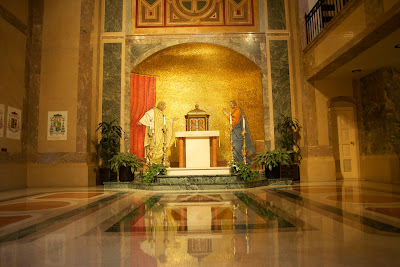
The Cathedral of Saint Matthew the Apostle creates an aural and visual atmosphere which encourages and nurtures prayers, reflection, and compassion. The Cathedral remains a welcoming quiet space where all thoughts, all concerns, all emotions are not expected to be directly expressed to everyone. Here is a place of love and spiritual development. Here is a place of goodness, kindness, holiness. A bouquet of mercy, compassion, and hope the doors of the Cathedral are often open, help and assistance can be found. Prayer offers a patient intensity. Prayer can lead to more humility, charity, obedience. Prayer can lead to personal discernment about life, vocation. The Cathedral is a very handsome space which photographs well with Brides and Grooms but the space is equally handsome for soul searching about personal themes about religious identity and cross cultural identity and reference points.

The Cathedral of Saint Matthew the Apostle is often at the epicenter of Washington, DC life. Homilies often refer to current topics, world leaders. Prayers are said for all mankind. Although the Cathedral is Catholic, prayers for peace, prayers for all humans are said each and every day. Love is not simply spoken of in the abstract but it is a vital important part of the life of this parish which relies upon the prayers and humanpower of many volunteers to fulfill the mission of the church.

The Cathedral is a place for human beings, a place for sinners, a place for the damaged and the broken, for the abandoned and the forgotten. It is a place to celebrate birth, death, and everything in between. It is a wonderful monument of hope and love. The Cathedral remains stubbornly accepting, stubbornly compassionate, stubbornly merciful to all of those who need it, to all of those who walk through the doors.

Here is a sheltering place of beauty. A place where silence is encouraged. Here is a place to escape the hurly-burly of a fast-paced, frantic life where everybody is psychotic or neurotic , where everybody is talking.

Here is a place for honest, simple communication.

Saturday, December 25, 2010

ABUNDANT JOY AND GREAT REJOICING - December 25, 2010

training us to reject godless ways and worldly desires and to live temperately, justly, and devoutly in this age Titus 2:12

It was a time of warmheartedness, a time of tenderheartedness surrounded by hope. There were thick white candles with delicate orange flames reaching toward the ceiling, dancing toward heaven.

How easy it is to forget the journey, to allow the moment, this minute to dominate the mind, the imagination. Life does not stop. Each minute flows into the next. Minutes flow into hours; hours flow into days. The journey continues whether we are prepared or not, whether we are able to upgrade or not. There is always motion, always a need for patience.

And here is a moment of delicate welcome, the lingering embrace of remembrance and forgiveness which recalls yesterday's hope, yesterday's love.

This is a moment of familiar songs, familiar sayings. For this instance the thick white candles offer reassurance, offer hope, offer continuity and faith. Here in this instance each individual is fine and dandy, each individual cannot complain. Here is a moment when good is allowed to triumph!

This is a moment of red and white and green leaves. This is a moment of soft lighting. This is a time to remember to be moral, to remember the Church's moral code. How romantic and perfect this night appears with the white lights on the evergreen trees. What a great moment to reflect upon personal morals. Each Christian is asked to live a morally-sound life of goodness, kindness, holiness; of charity, humility, and service to God. Each day provides opportunities for moralistic evaluations and decisions. Each day provides opportunities for honor, good character. Remember that each candle has one purpose: to provide light. High ideals are great companions to have as we walk on the right road, following the footsteps of Jesus Christ.

Sharing love and hope freely, gently is always a boon. Each day we are given an opportunity to exalt the goodness, the mercy, the presence of God in our lives. We constantly make choices. We must remember to do what is productive for God, what is beneficial to God. As Christians, God must always be an active part of our individual decision making process.

The candles stand guard, patiently sacrifice their wax to provide light. Allow each Mass to be a pilgrimage, an expedition to holiness, to love universal and unconditional.